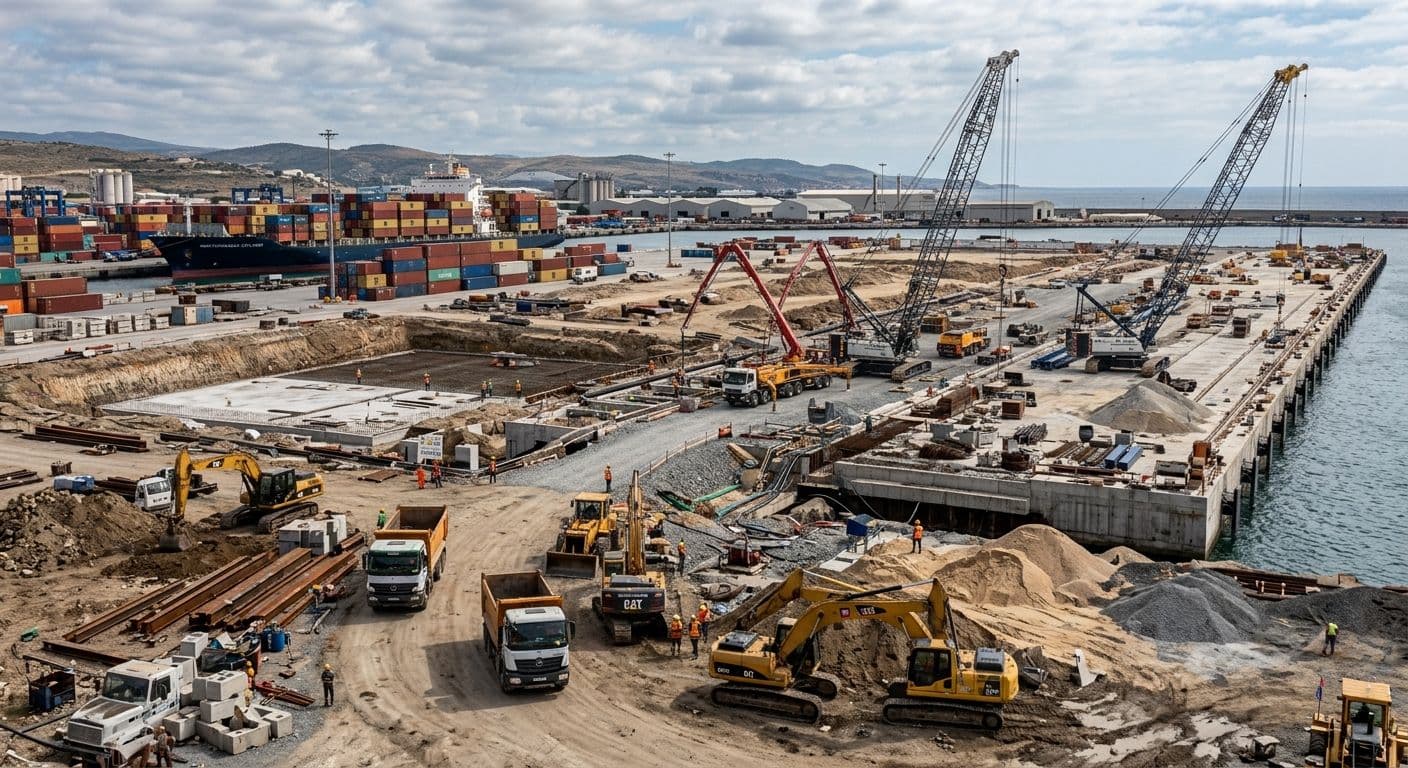

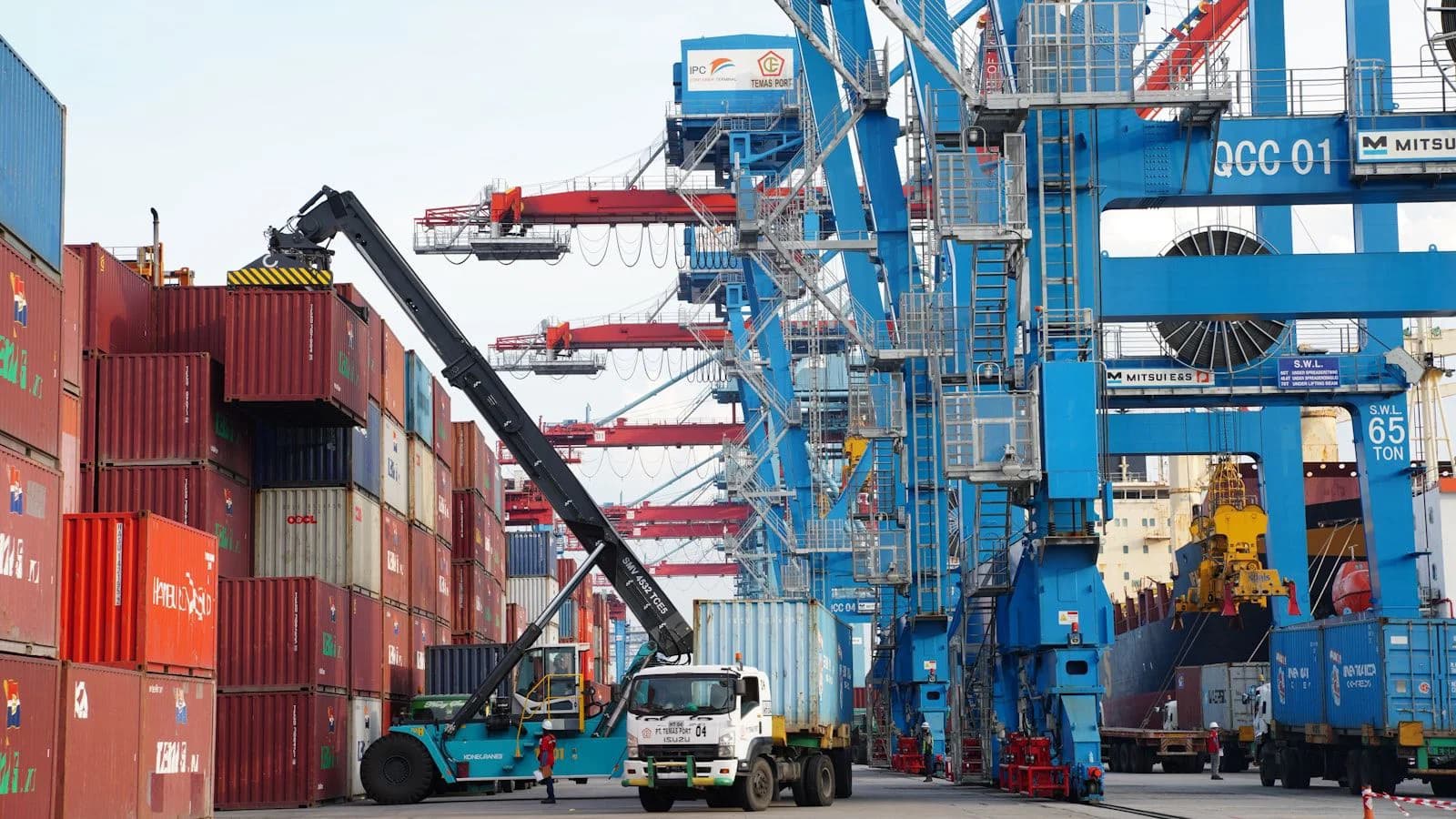
On any given day a port terminal hosts a workforce it does not directly employ. Contractors arrive to carry out crane and equipment maintenance, civil works on quay walls and pavements, electrical and mechanical repairs, statutory inspections, fendering and mooring upgrades, painting, confined space cleaning and a long list of specialist tasks that keep the facility running. They are indispensable. They also concentrate a disproportionate share of the terminal's safety and security exposure. Managing them with paper, spreadsheets and email does not scale, and at a busy terminal it quietly becomes one of the weakest points in the entire HSSE system.
This article sets out why contractors concentrate risk, what manual contractor management actually costs, what a complete digital contractor lifecycle looks like stage by stage, and how to measure whether it is working. It is written for terminal operations managers and HSSE managers who already understand the problem and want a clear, practical model for fixing it.
Why contractors concentrate risk
A directly employed terminal workforce is, in HSSE terms, relatively knowable. People are trained to a consistent standard, inducted once and re-inducted on a schedule, familiar with the site layout and traffic routes, and visible to supervisors every day. Contractors break almost every one of those assumptions.
- They are unfamiliar with the site. A contractor electrician may be excellent at their trade and still not know which roadways carry reach stackers, where the restricted areas begin, or what the terminal's evacuation signal sounds like.
- They change constantly. The contractor working on a project this month may be replaced by a different crew, from a different company, next month. Institutional safety knowledge does not accumulate the way it does with permanent staff.
- They perform the highest-hazard work. Hot work, work at height, lifting operations, confined space entry, electrical isolation and excavation are frequently contracted out. The tasks that most need rigorous control are precisely the ones performed by the people the terminal knows least.
- They sit across an information gap. The terminal does not automatically know whether a contractor's training is current, whether their employer holds valid liability insurance, or whether an individual has the specific competency the task demands. That information lives with the contracting company, and only reaches the terminal if someone asks for it and checks it.
- Their work interacts with live operations. Contractor activity rarely happens in isolation. It takes place alongside container handling, vessel operations and vehicle movement, which means a contractor error, or a failure to coordinate, can propagate into the wider terminal.
None of this means contractors are careless. It means the terminal carries the residual risk of a workforce it did not select, train or supervise day to day, and it can only manage that risk through the quality of its contractor management system. When that system is manual, the risk is managed badly.
What manual contractor management actually costs
The cost of paper-based contractor management is easy to underestimate because it is spread thinly across many days and many people. It rarely appears as a single line in a budget. It shows up instead as friction, exposure and lost time.
Delays at the gate and the worksite
When induction status, authorisation and document validity are checked manually, the gate becomes a bottleneck. A guard holds up a contractor while a phone call confirms whether they are expected, whether their induction is still valid, and who authorised the visit. Multiply that across every contractor on a busy morning and the terminal loses productive hours, contractor crews stand idle while the terminal pays for them indirectly through project cost, and the pressure to simply wave people through grows. That pressure is itself a hazard.
Expired credentials going unnoticed
Insurance policies lapse. Training certificates expire. Medical fitness assessments fall due. In a spreadsheet, an expiry date is just a cell, and nobody is reliably watching it. A contractor company can be operating on the terminal with lapsed liability cover, or a worker can be performing a task on a certification that expired weeks ago, and the terminal will not discover it until an audit, or an incident, forces the question.
Audit findings and weak evidence
When a flag state, port state control, a certification body or an insurer asks the terminal to demonstrate control of contractors, paper records make that difficult. Files are incomplete. Sign-in sheets are illegible or missing. Induction records cannot be matched to access events. The terminal may genuinely be managing contractors well in practice and still fail an audit because it cannot produce the evidence. Findings then consume management time in corrective action.
Incidents driven by training and coordination gaps
The most serious cost is the incident that should not have happened: a contractor injured because they were never inducted into a site-specific hazard, or because work proceeded without the coordination that a permit would have forced. After the event, a manual system makes the investigation slower and the root cause harder to prove, because the timeline has to be reconstructed from fragments.
No real-time picture
Perhaps the most basic failure of manual systems is that nobody can answer a simple question at any given moment: who is on site right now, where, and for what task. In an emergency, that question is not academic. Without a live, accurate picture, mustering and accounting for people becomes guesswork.
The contractor lifecycle, stage by stage
Good digital contractor management is not a single feature. It is a controlled lifecycle that begins before a worker reaches the terminal and ends only when the work is signed off and the records are closed. Each stage is a checkpoint, and each checkpoint reduces the risk that an unprepared person, an unqualified company or an uncontrolled task enters the facility.
1. Company pre-qualification
Before any individual worker is discussed, the contracting company itself should be assessed. Pre-qualification is where the terminal decides whether a company is fit to work on site at all. The company submits, through a structured digital process rather than a loose email exchange, the evidence the terminal requires: business registration, liability and workers' compensation insurance, safety policies and method statements, relevant accreditations, and a safety performance history. The terminal reviews this once, records the outcome, and approves the company for a defined scope of work and a defined period. A digital system keeps that approval visible and tied to expiry dates, so a company cannot quietly drift out of compliance while still being treated as approved.
2. Worker registration
Once a company is approved, its individual workers are registered. Each worker has a single identity in the system, carrying their personal details, their employer, their role, and the documents and competencies attached to them. Registering workers individually, rather than treating a contractor company as an anonymous block, is what makes everything downstream possible: induction, authorisation, access and oversight all attach to a named person.
3. Document and certification management
This is the core of the system. For both companies and individuals, the terminal defines which documents and certifications are required, for example trade qualifications, equipment operator licences, medical fitness records, specialist training for hot work or confined space entry, and the company's insurance. Each document is uploaded, recorded with its issue and expiry date, and verified. The principle is simple but powerful: a worker or company with an incomplete or expired document set cannot progress to the next stage. The terminal stops relying on someone remembering to check, and starts relying on the system refusing to advance.
4. Induction
Every contractor worker completes a safety induction before they are allowed to work. A digital induction delivers consistent content to every worker: the terminal's HSSE rules, site-specific hazards, traffic and pedestrian routes, restricted areas, emergency procedures, muster points and reporting obligations. It can be completed in advance or on arrival, it can be offered in multiple languages, and it can confirm understanding through a short assessment. Crucially, completion is recorded against the worker's identity with a time stamp and a validity period, so the terminal always knows who has a current induction and who does not. The wider case for this is covered in how digital safety inductions reduce incidents.
5. Authorisation
Pre-qualification, registration, documents and induction establish that a worker is eligible to be on site. Authorisation is the separate decision that a specific worker, or crew, is approved for a specific scope of work, for a specific period, at a specific location. It is the point at which a responsible person at the terminal takes ownership of that contractor's presence. Authorisation should never be automatic. It is a deliberate act, and a digital system records who granted it, for what, and until when.
6. Access control
Access is where the entire lifecycle is enforced. Only a worker who is registered, holds valid documents, has a current induction and a live authorisation should be able to enter. A digital system makes this enforcement automatic at the gate: the worker's status is checked instantly, and entry is granted or refused on that basis, with no judgement call required from a guard under time pressure. This also satisfies a regulatory expectation. Under the IMO's ISPS Code, a port facility must control access to the facility and to its restricted areas, and contractors are squarely within the population that control must cover. Tying access to a verified contractor record turns a security requirement into a routine, repeatable process. The mechanics of managing arrivals are covered further in visitor and contractor management at ports.
7. Linking access to a valid permit to work
For higher-hazard activities, being authorised and inducted is necessary but not sufficient. Hot work, work at height, confined space entry, energy isolation and similar tasks should proceed only under a permit to work that confirms the specific hazards have been assessed and controlled for that job, on that day. The strongest contractor management systems connect the two: a contractor crew's access and activity for a hazardous task is tied to a valid, active permit, so the task cannot proceed if the permit has not been issued or has expired. This closes the gap between a person being allowed on site and a specific dangerous task being properly controlled. The discipline behind this is set out in permit to work at port terminals.
8. On-site oversight
While contractors are working, the terminal needs a live, accurate view of who is on site, from which company, for what task, and where. This is partly a safety function: in an emergency, the muster process depends on knowing exactly who to account for. It is partly a supervisory function: oversight lets the terminal confirm that contractor numbers, locations and activities match what was authorised. A real-time record replaces the unreliable sign-in sheet, and the question of whether anyone is still in a given area has a definite answer.
9. Sign-off and close-out
Contractor management does not end when the work finishes. The visit and the work should be formally closed: workers signed off site, permits closed, any issues or observations recorded, and the records finalised. Close-out ensures the terminal does not carry contractors as present when they have left, keeps the live picture accurate, and completes the record for that piece of work.
Credential and insurance expiry: managing time, not just documents
It is worth isolating one theme that runs through the whole lifecycle, because it is where manual systems fail most predictably. Contractor compliance is not a state, it is a state that decays. A document that is valid today expires on a known date. Insurance renews annually. Certifications have defined lifespans. Medical assessments fall due.
A manual system treats these as static records and depends entirely on a person noticing. A digital system treats them as time-bound objects: every document carries its expiry date, the system tracks the approach of that date, it can alert the contractor and the terminal in advance, and it can automatically prevent a worker or company from progressing once a critical document has lapsed. The shift is from holding a copy of the certificate to knowing the certificate is valid right now, with the system refusing to let anyone act as if it is when it is not. That distinction is the difference between paperwork and control.
The audit trail
Every stage above generates a record, and together those records form a continuous, time-stamped audit trail: which company was pre-qualified and on what evidence, which workers were registered, which documents were verified and when they expire, which inductions were completed, who authorised what, every access event, every permit, and every sign-off.
The value of that trail is twofold. Day to day, it supports good management: it lets the terminal answer questions immediately and act on what it sees. When something goes wrong, it is decisive. An incident investigation that would have taken days of reconstructing fragments from sign-in sheets and memory becomes a matter of reading an existing, reliable timeline. And when an external party, a flag state inspector, port state control, a certification body or an insurer, asks the terminal to demonstrate that it controls contractors, the evidence is already assembled, consistent and exportable. Good record-keeping is not a by-product of digital contractor management. It is one of its main deliverables.
What to measure
Digitalising contractor management should be judged on operational outcomes, not on the fact that a tool was deployed. A practical set of measures includes:
- Gate processing time for contractors, and the reduction in time lost to manual checks.
- The proportion of contractor entries where induction, authorisation and documents were all valid at the moment of access.
- The number of attempted entries refused because a credential was missing or expired, which shows the controls are actually catching problems rather than being bypassed.
- Credential and insurance expiry lead time: how far in advance lapses are identified and resolved.
- Contractor-related incidents and near misses, tracked over time, with attention to those linked to training or coordination gaps.
- Time required to produce a complete contractor record or incident timeline for an audit or investigation.
- Coverage: the share of contractor activity actually running through the system, since a process that is bypassed protects no one.
A contractor management system is only as strong as its weakest bypass. If crews can reach the worksite without passing through the controls, the terminal has documentation, not control.
Rolling it out: change management
Introducing digital contractor management changes how people work, at the gate, in the HSSE office and in every contracting company. Treating it purely as a software installation is the most common way to undermine it.
- Engage contractors early. The contracting companies are users of the system too. They submit pre-qualification evidence and register workers. Explaining the process, and the fact that it speeds up gate access once documents are in order, turns them from obstacles into participants.
- Bring the gate and security team in from the start. They will rely on the system every shift. Their input on how access decisions are presented and handled is essential, and their confidence in the system determines whether it is used as intended or quietly worked around.
- Phase the rollout. Beginning with a defined contractor population or a single category of work allows the terminal to refine the process before extending it. A controlled start builds credibility.
- Set document requirements deliberately. Requirements should be demanding enough to manage real risk and realistic enough to be met. Requirements that contractors cannot satisfy invite workarounds.
- Communicate the reason. Operations managers, HSSE staff and contractors should understand that the goal is fewer incidents, faster legitimate access and defensible records, not bureaucracy for its own sake.
Underpinning all of this is occupational health and safety law. Across jurisdictions, terminal operators carry duties toward people who work on their premises regardless of who employs them, and contracting companies carry duties toward their own workers. Examples include the marine terminals standard issued by OSHA in the United States as 29 CFR Part 1917, and the broader occupational safety regimes of the European Union and the United Kingdom. The detail differs, but the shared principle is constant: the terminal cannot contract away its responsibility for what happens to people on its site. A digital contractor management system is, in large part, how a terminal discharges that shared responsibility in a structured and demonstrable way.
How Stowlog supports contractor management
Stowlog is HSSE software built specifically for port and terminal facilities, and contractor management is one of its core areas. Rather than a collection of disconnected tools, it brings the full lifecycle described above into a single platform.
- Company pre-qualification, with structured submission and review of insurance, accreditations and safety documentation.
- Worker registration, giving every contractor individual a single identity that carries their documents, certifications and history.
- Document and certification management, with issue and expiry dates tracked, advance alerts before lapses, and progression blocked when a critical document is not valid.
- Digital inductions, delivered consistently to every worker, recorded against their identity with a time stamp and validity period.
- Authorisation and access control, so only registered, documented, inducted and authorised workers enter, with the access decision enforced automatically.
- Permit to work, so that access and activity for hazardous tasks can be tied to a valid, active permit.
- Real-time oversight, giving the terminal a live view of who is on site, from which company, and for what task.
- A complete, time-stamped audit trail across every stage, exportable for audits and investigations.
The result is that contractor management stops being a manual burden spread across spreadsheets, binders and phone calls, and becomes a controlled, measurable process. Incidents caused by insufficient training and poor coordination are reduced, the gate moves faster for legitimate contractors, and traceability is immediate rather than reconstructed after the fact. For a wider view of how this fits alongside visitor handling and the broader discipline, see the visitor and contractor management category, and the practical guide to contractor onboarding at port terminals.
Sources and further reading
Frequently asked questions
Why do contractors represent a higher safety and security risk than directly employed staff?
Contractors are less familiar with the site, change frequently, and often perform the highest-hazard tasks such as hot work, work at height and confined space entry. The terminal also sits across an information gap, because a contractor's training status, competencies and insurance are held by the contracting company and reach the terminal only if they are actively requested and checked.
What is the difference between pre-qualification and authorisation?
Pre-qualification assesses whether a contracting company is fit to work on site at all, based on its insurance, accreditations, safety policies and performance history. Authorisation is the separate, deliberate decision that a specific worker or crew is approved for a specific scope of work, at a specific location, for a specific period.
How does digital contractor management help with credential and insurance expiry?
Each document is recorded with its issue and expiry date and treated as a time-bound object rather than a static file. The system tracks approaching expiry dates, alerts the contractor and the terminal in advance, and can block a worker or company from progressing once a critical document has lapsed.
What does the ISPS Code require in relation to contractors?
The IMO's ISPS Code requires a port facility to control access to the facility and to its restricted areas. Contractors fall squarely within the population that this control must cover, so tying contractor access to a verified, up-to-date record is a practical way of meeting that requirement.
Should contractor access be linked to a permit to work?
For higher-hazard activities such as hot work, work at height and confined space entry, yes. Being inducted and authorised confirms a worker is eligible to be on site, but a permit to work confirms that the specific hazards of that task have been assessed and controlled, so linking the two prevents a dangerous task from proceeding without a valid permit.
What should a terminal measure to know if digital contractor management is working?
Useful measures include gate processing time, the proportion of entries where induction, authorisation and documents were all valid, the number of entries refused because of missing or expired credentials, expiry lead time, contractor-related incidents and near misses, and the time needed to produce a complete record for an audit. Coverage also matters, since a process that is bypassed protects no one.
Does a digital system remove the terminal's legal responsibility for contractors?
No. Under occupational health and safety regimes worldwide, a terminal operator carries duties toward everyone working on its premises regardless of who employs them, and that responsibility cannot be contracted away. A digital contractor management system is the means by which a terminal discharges that responsibility in a structured and demonstrable way.
How should a terminal roll out digital contractor management without disrupting operations?
Engage contracting companies and the gate and security team early, since both are daily users of the system. Phase the rollout by starting with a defined contractor population or category of work, set document requirements that are demanding but realistic, and communicate that the goal is fewer incidents and faster legitimate access rather than added bureaucracy.
Why is a continuous audit trail important for contractor management?
A time-stamped record of pre-qualification, documents, inductions, authorisations, access events, permits and sign-offs lets the terminal answer questions immediately and act on what it sees. When an incident occurs or an external party requests evidence of control, the timeline is already assembled and consistent rather than reconstructed from fragments.