
The real problem is the handoff
When data lives in separate systems, people become the connection. Someone re-types a visitor from one screen into another. Someone checks two lists before letting a contractor through. Someone finds out an hour late that a driver was suspended or a permit expired.
These gaps rarely show up on a dashboard, but they add up. Processes slow down, records disagree, and audit evidence ends up spread across files. The bigger the facility, the more handoffs there are to break.
What a public API is, in plain language
An API is a set of rules that lets one piece of software ask another for data, or send it an instruction. A public API is one that is documented openly, so customers and partners can build on it without a custom project each time.
Most modern ones follow the REST style and return data as JSON. A system asks a question, such as "is this visit approved?", and gets a structured answer it can act on immediately. Industry bodies such as the Digital Container Shipping Association already publish open API standards for container shipping, which shows where the sector is heading.
Five benefits for terminals and port authorities
- Automate decisions at the gate. A gate or access system can check a visit's status and a person's induction before it lets them through, with no one looking up a second screen.
- Enforce a rule once, everywhere. If a worker is suspended in the safety platform, your gate and your terminal system can read that status and act on it, instead of relying on someone to pass the message along.
- Keep one source of truth. Data entered once is available wherever it is needed. That means less re-typing, fewer mismatches and cleaner records.
- Integrate faster, and depend less on one vendor. With documented endpoints, a connection takes less effort than a bespoke project, and you can change one system without rebuilding every link.
- Make room for new technology. Telematics, digital twins, emissions reporting and analytics tools all need data from the facility. A public API gives them a standard way in.
Four everyday scenarios
- Gate checks. Before a visitor or contractor enters, the access system confirms the visit is approved and the induction is valid.
- Suspension enforcement. The gate flags suspended users and denies entry.
- Driver notifications. A status change in the terminal system triggers a push notification to the driver's phone.
- Live equipment on the map. Positions from machine telematics feed a live map of the terminal, so operations sees equipment and people in one view.
None of these needs a new product. They need systems that can talk to each other.
What to look for in a port software API
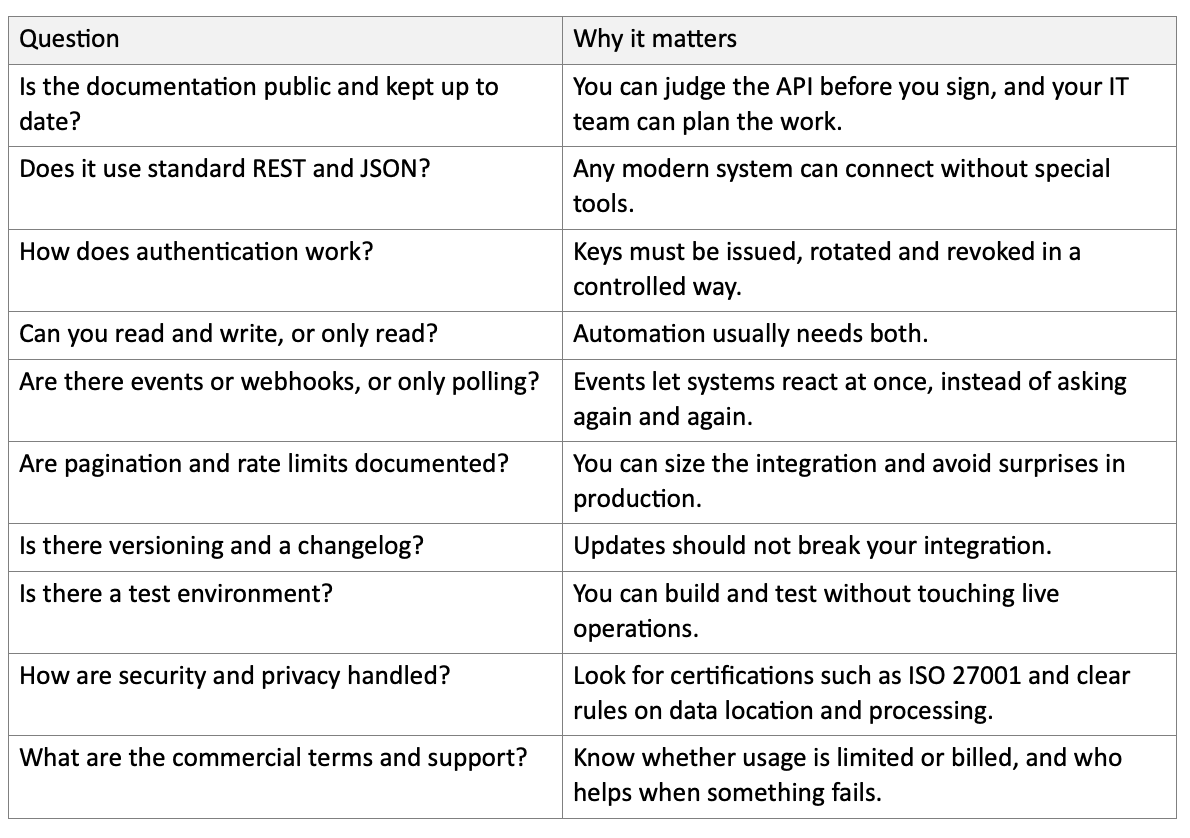
Not every API is equally useful. Before you commit, ask these ten questions.
Common pitfalls
- "Available on request" documentation. If the specification is a PDF sent after a sales call, the API is closed in practice.
- Read-only access. You can see the data, but you cannot automate anything with it.
- Polling as the only option. Systems that must ask every few seconds waste effort and still react late.
- Unclear fees. Usage-based pricing is fair, but it should be stated up front.
- Out-of-date docs. An API that has changed while its documentation has not is a project risk.
How Stowlog approaches it
Stowlog is a platform for safety, security and compliance in ports and terminals, and its Public API is documented openly. It is a REST API that returns JSON, with paginated lists and requests validated by an API key.
It covers visits and visit activity logs, safety inductions, suspensions, live geoposition data and assets, notifications, and facility data such as custom fields and user types. You can test each endpoint with your own key in the documentation. Stowlog is ISO 27001-certified and hosts personal data in the EU. If an endpoint you need is missing, tell us and we will look at it.
Open systems make safer, faster ports
A connected terminal is not one with more software. It is one where the software it already has shares what it knows. A public API is the simplest way to get there, and the questions above are a good way to judge whether a vendor's API will hold up in real operations. Ready to connect your systems? Request API access, or read the API documentation to see what is available today.